← Neurological and sensory research
RESEARCH PROTOTYPE
Incus.
A localized synthetic defect in a human incus from a donor temporal bone.
Download reference model 3MF · mmDownload enlarged teaching model 3MF · 5× scale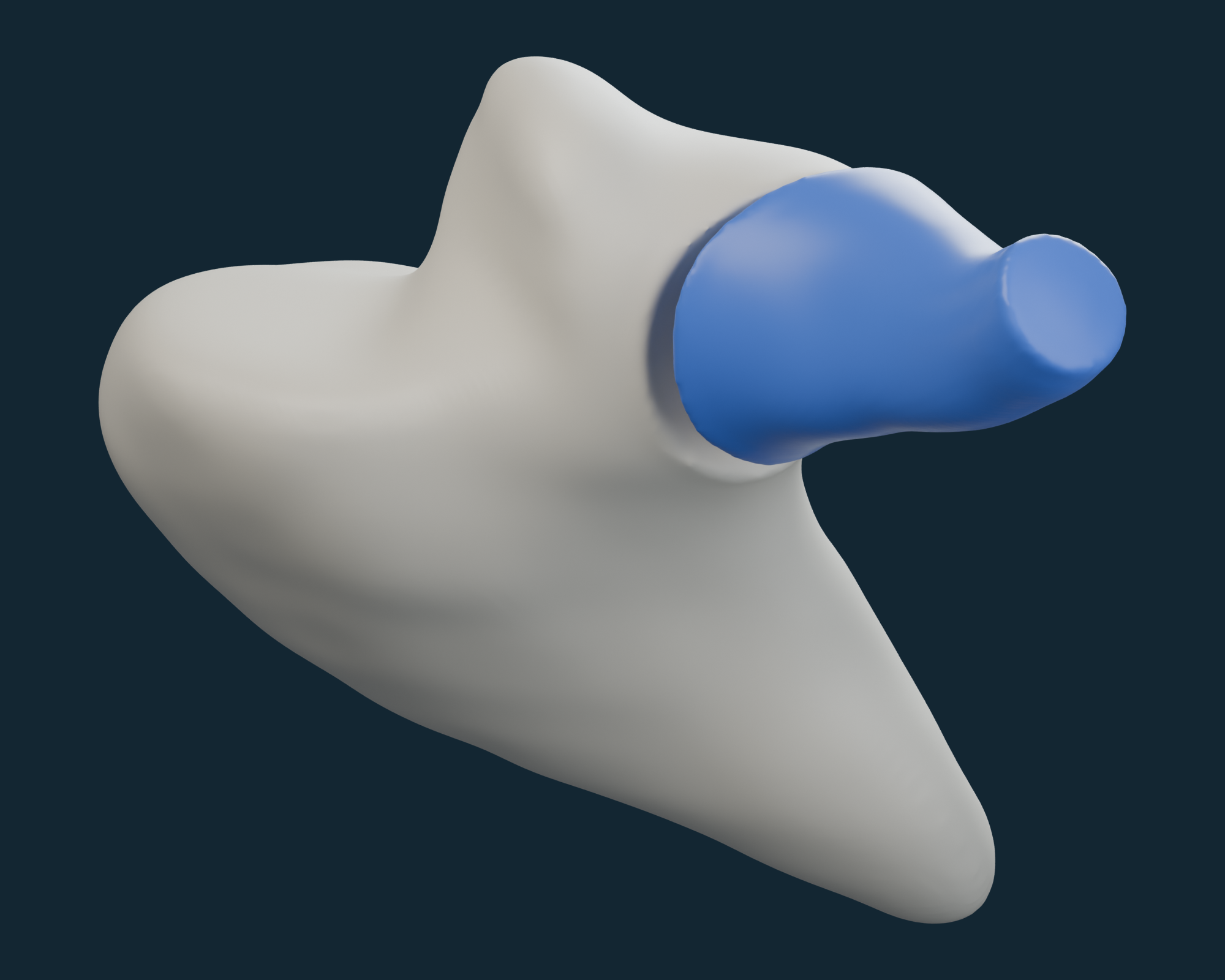
2.0 mm³Reference volume
0.000Proposal Dice overlap
0%Target coverage
1 mNReference axial load
What we tested.
- Source and defect
- Source specimen DELTA. An ellipsoidal cut removed 2.0 mm³. Its original shape provides the known reference for this experiment.
- Bench model
- The reference download is a closed surface with 535,104 triangles in millimetres. After smoothing, the 95th-percentile sampled surface distance from the original reference was 0.047 mm. At natural scale, the tested 0.4 mm nozzle profile skipped one interior layer. The 5× teaching edition produced 63 consecutive layers at 0.15 mm layer height.
- Reconstruction experiment
- The generated surface missed the entire removed region. The interactive surface shows the known removed anatomy.
- Bench simulation
- The blue reference underwent a two-resolution bench test with nominal homogeneous unfilled PEEK properties. One end band was held fixed and the other carried a 1 mN axial pull. The fine solve used 44,428 elements and gave a maximum displacement of 0.00000338 mm. Two conduction solves held one end at 37 °C and the other at 20 or 45 °C, with insulated free surfaces. The field views preserve the surface used by the solver. Downloads contain the smoothed bench geometry.
- Next experiment
- An incus-specific donor-atlas prototype reached mean Dice 0.757 across 14 simulated defects in seven held-out specimens. On this DELTA challenge, its Dice was 0.545 with a coarse search box.
Threshold comparison
Each threshold produced a separate model run. We compared the full output and its largest connected component against the known reference.
| Threshold | Surface | Dice overlap |
|---|---|---|
| 0.50 | Full output | 0.000 |
| 0.50 | Largest component | 0.000 |
| 0.25 | Full output | 0.000 |
| 0.25 | Largest component | 0.000 |
| 0.75 | Full output | 0.000 |
| 0.75 | Largest component | 0.000 |
Sieber et al. · OpenEar temporal bone library · CC BY 4.0 Adaptations include digital defect creation, surface extraction and field mapping. OpenEar temporal bone library · CC BY 4.0